Publications
Research Publications

Age and cohort rise in diabetes prevalence among older Australian women: case ascertainment using survey and healthcare administrative data.

Wubishet, B., Harris, M., Forder, P. and Byles, J. (2020). Plos One

Budgeting
Working Papers

Taxation and policyholder behavior: the case of guaranteed minimum accumulation benefits

Jennifer Alonso-García, Michael Sherris, Samuel Thirurajah and Jonathan Ziveyi

Abstract: This paper considers variable annuity contracts embedded with guaranteed minimum accumulation benefit (GMAB) riders when policyholder's proceeds are taxed. These contracts promise the return of the premium paid by the policyholder, or a higher stepped up value, at the end of the investment period. A partial differential valuation framework, which exploits the numerical method of lines, is used to determine fair fees that render the policyholder and insurer profits neutral. Two taxation regimes are considered; one where capital gains are allowed to offset losses and a second where gains do not offset losses, reflecting  stylized institutional arrangements in Australia and the US respectively. Most insurance providers highlight the tax-deferred feature of a variable annuity. We show that the regime under which the insurance provider is taxed significantly impacts  supply and demand prices. If losses are allowed to offset gains then this enhances the market, narrowing the gap between fees, and even producing higher demand than supply fees. On the other hand, when losses are not allowed  to offset gains, then the demand-supply gap increases. When charging the demand price, we show that insurance companies would be profitable on average. Low (high) Sharpe ratios are not as profitable as policyholders are more likely to stay long (surrender).

Keywords: taxation; retirement income;  policyholder behavior;  pricing;  method of lines;  surrender;  variable annuity

health data
Working Papers

Health Shocks and the Evolution of Earnings over the Life- Cycle

Elena Capatina, Michael Keane and Shiko Maruyama

Abstract: We study the contribution of health shocks to earnings inequality and uncertainty in labor market outcomes. We calibrate a life-cycle model of labor supply and savings that incorporates health and health shocks. Our model features endogenous wage formation via human capital accumulation, employer sponsored health insurance, and means- tested social insurance. We find a substantial part of the impact of health shocks on earnings arises via reduced human capital accumulation. Health shocks account for 15% of lifetime earnings inequality for U.S. males, with two-thirds of this due to behavioral responses. In particular, it is optimal for low-skill workers – who often lack employer sponsored insurance – to curtail labor supply to maintain eligibility for means-tested transfers that protect them from high health care costs. This causes low-skill workers to invest less in human capital. Provision of public health insurance can alleviate this problem and enhance labor supply and human capital accumulation.

Keywords: Health, Health Shocks, Human Capital, Income Risk, Precautionary Saving, Earnings Inequality, Health Insurance, Welfare


Research Publications

Ageing of the Aboriginal and Torres Strait Islander population: numerical, structural, timing and spatial aspects

Temple, J., Wilson, T., Taylor, A., Kelaher, M. and Eades, S. (2020). Australian & New Zealand Journal of Public Health 44(4): 271-278.

Research Publications

Retirees’ perceptions of goal setting: A qualitative study.

Dudley, D., O’loughlin, K., Lewis, S. and Loh, V. (2020). Australasian Journal on Ageing. 39(3), e360-e367.

Elderly couple researching pension options
Working Papers

Optimal Intergenerational Transfers: Public Education and Pensions

Monisankar Bishnu, Shresth Garg, Tishara Garg and Tridip Ray

Abstract:In presence of imperfections in education loan market, the standard policy response of intervening solely on education front, funded through taxes and transfers, necessarily hurts the initial working population. The literature suggests compensating them via pay-as-you-go pensions as a possible solution. But for various reasons sustainability of PAYG pensions is under serious doubt. We carry out the optimal policy exercise of a utilitarian government in a dynamically ecient economy with pension and education support obeying the Pareto criterion. We find that expansion of one instrument along with the other emerges as the optimal response, however, once the complete market level of education is achieved, the optimal policy suggests phasing pensions out. Eventually, government leads the economy to an equilibrium with zero pension and the Golden Rule level of education. This is achieved by exploiting only market opportunities without relying on other factors including human capital externalities, general equilibrium effects or socio-political factors.

Keywords: Public education; PAYG pension; intergenerational transfers; welfare state

CEPAR industry report
Working Papers

Time Inconsistency and Endogenous Borrowing Constraints

Joydeep Bhattacharya, Monisankar Bishnu and Min Wang

Abstract: This paper studies the welfare of time-inconsistent, partially sophisticated agents living un- der two different regimes, one with complete, unfettered credit markets (CM) and the other with endogenous borrowing constraints (EBC) where the borrowing limits are set to make agents indifferent between defaulting and paying back their unsecured loans. The CM regime cannot deliver the first best because partially sophisticated agents would undo plans laid out by previous selves and borrow too much. Somewhat counterintuitively, in some cases, the EBC regime may deliver higher welfare than the CM regime. These results speak to the aca- demic debate surrounding the creation and functioning of the CFPB (Consumer Financial Protection Bureau) in the U.S. and its implementation of the ability-to-repay rule on lenders after the 2007-8 crisis. Such institutions generate commitment publicly and may help time- inconsistent agents economize on the costs of private commitment provision.

Keywords: endogenous borrowing constraints, overborrowing, financial protection

Research Publications

A Patient-Level Model to Estimate Lifetime Health Outcomes of Patients With Type 1 Diabetes

Tran-Duy, A., Knight, J., Palmer, A.J., Petrie, D., Lung, T.W.C., Herman, W., Eliasson, B., Svensson, A. and Clarke, P. (2020). Diabetes Care. 44(3)

Research Publications

Components of disability exclusion: discrimination, avoidance and accessibility in later life.

Temple, J., Kelaher, M., Utomo, A., Williams, R. and Brooke, L. (2020). Australasian Journal on Ageing. 39 (2), 101-111.

Conversation
Working Papers

Building Better Retirement Systems in the Wake of the Global Pandemic

Olivia S. Mitchell

Abstract: In the wake of the global pandemic known as COVID-19, retirees, along with those hoping to retire someday, have been shocked into a new awareness of the need for better risk management tools to handle longevity and aging. This paper offers an assessment of the status quo prior to the spread of the coronavirus, evaluates how retirement systems are faring in the wake of the shock. Next we examine insurance and financial market products that may render retirement systems more resilient for the world’s aging population. Finally, potential roles for policymakers are evaluated.

Keywords: COVID-19, retirement, financial market, aging population

Research Publications

Do factors across the World Health Organisation’s International Classification of Functioning, Disability and Health framework relate to caregiver availability for community-dwelling older adults in Ghana?

Awuviry-Newton, K., Wales, K., Tavener, M. and Byles, J. (2020). PloS One. 15 (5). 

Research Publications

Life Satisfaction of Middle‑Aged and Older Chinese: The Role of Health and Health Insurance

Yang, S., and Hanewald, K. (2020). Social Indicators Research.


Research Publications

To what extent is Australia’s population ageing? The application of traditional and alternative ageing measures.

Wilson, T. and Temple, J. (2020). Australian Population Studies. 4(1), 57-69.

Research Publications

To What Extent is Australia’s Population Ageing? The Application of Traditional and Alternative Ageing Measures

Wilson T and Temple J (2020). Australian Population Studies 4(1): 57-69.

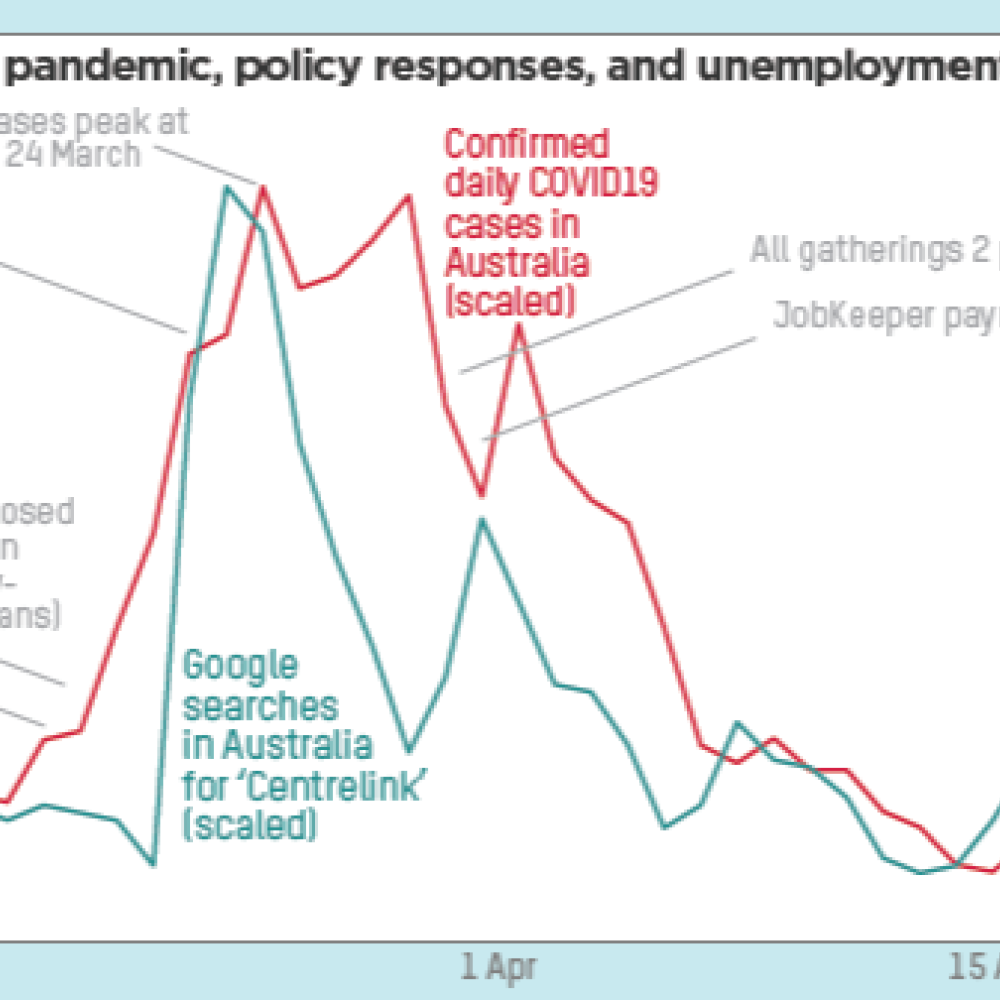
Timing of unfolding pandemic, policy responses, and unemployment concerns (Australia)
Fact Sheets

COVID-19 and the Demographic Distribution of Health and Economic Risks

Rafal Chomik

The health impacts of COVID-19 have been modest in Australia compared to elsewhere. But as restrictions ease and the economy reopens, the risks of infection, morbidity, and job loss will require caution. Live data suggests that unemployment impacts may be considerable.

Such risks are shared unequally across locations, occupations, and industries. A key driver of differences is age and socioeconomic status. For example, areas with less healthy populations - where a resurgence in COVID-19 could wreack the most havoc - tend to be either older, poorer, or both.

Occupations with greatest exposure to infection tend to be low wage, and often held by older women. And, while older workers have so far seen lower rates of job loss than younger workers, historic data suggests that they are twice as likely to become inactive after a spell of unemployment. Such multi-dimensional risks need balanced and informed responses.

To this end, this fact sheet documents the demographic distribution of different health and economic risks across the Australian population, paying particular attention to older groups (aged 55+).

Research Publications

The lagged influence of organizations' human resources practices on employees’ career sustainability: The moderating role of age.

Tordera, N., Peiro’, J. M., Ayala, N., Villajos, E., & Truxillo, D. M. (2020). Journal of Vocational Behavior. 120 Article 103444.

Research Publications

Comparison of clinical risk factors for incident fracture in obese and non-obese community-dwelling older men.

Scott, D., Seibel, M.J., Cumming, R.G., Naganathan, V., Blyth, F.M., Le Couteur, D.G., Handelsman, D.J., Hsu, B., Waite, L.M. and Hirani, V. (2020). Bone. 137. 

Research Publications

Healthy life expectancy in China: Modeling and implications for public and private insurance

Li, H., Hanewald, K., and Wu, S. (2020). Annals of Actuarial Science. p.1-17

Research Publications

APOE e4 and the influence of sex, age, vascular risk factors, and ethnicity on cognitive decline.

Makkar, S.R., Lipnicki, D.M., Crawford, J.D., Kochan, N.A., Castro-Costa, E., Lima-Costa, M.F., Diniz, B.S., Brayne, C., Stephan, B., Matthews, F., Llibre-Rodriguez, J.J., Llibre-Guerra, J.J., Valhuerdi-Cepero, A.J., Lipton, R.B., Katz, M.J., Wang, C., Ritchie, K., Carles, S. and Carriere, I. (2020). The Journals of Gerontology. 75(10),1863-1873.

Research Publications

APOE ε4 and the Influence of Sex, Age, Vascular Risk Factors, and Ethnicity on Cognitive Decline.

Makkar, S.R., Lipnicki, D.M., Crawford, J.D., Kochan, N.A., Castro-Costa, E., Lim-Costa, M.F., Diniz, B.S., Brayne, C., Stephan, B., Matthews, F.,  Libre-Rodriguez, J.J., Libre-Guerra, J.J., Valhuerdi-Cepero, A.J., Lipton, R.B., Katz, M.J., Wang, C., Ritchie, K., Carles, S., Carriere, I., Scarmeas, N., Yannakoulia, M., Kosmidis, M., Lam, L., Chan, W.C., Fung, A., Guaita, A., Vaccaro, R., Davin, A., Kim, K.W., Suh, S.W., Riedel-Heller, S.G., Roehr, S., Pabst, A., Ganguli, M., Hughes, T.F., Snitz, B., Anstey, K.J., Cherbuin, N., Easteal, S., Hann, M.N., Aiello, A.E., Dang, K., Ng, T.P., Brodaty, H., Trollor, J.N., Leung, Y., Lo, J.W. and Sachdev, P. (2020). The Journals of Gerontology: Series A, Biological Sciences and Medical Sciences.

Policy Dialogue
Working Papers

Consumer Panic in the COVID-19 Pandemic

Michael Keane and Timothy Neal

Abstract: We develop an econometric model of consumer panic (or panic buying) during the COVID-19 pandemic. Using Google search data on relevant keywords, we construct a daily index of consumer panic for 54 countries from January to late April 2020. We also assemble data on government policy announcements and daily COVID-19 cases for all countries. Our panic index reveals widespread consumer panic in most countries, primarily during March, but with significant variation in the timing and severity of panic between countries. Our model implies that both domestic and world virus transmission contribute significantly to consumer panic. But government policy is also important: Internal movement restrictions - whether announced by domestic or foreign governments - generate substantial short run panic that largely vanishes in a week to ten days. Internal movement early in the pandemic generated more panic than those announced later. In contrast, travel restrictions and stimulus announcements had little impact on consumer panic. 

Keywords: Coronavirus, Hoarding, Consumption, Panel Data, Containment Policy 


Research Publications

Role of apolipoprotein E epsilon 4 (APOE*e4) as an independent risk factor for incident depression over a 12-year period in cognitively intact adults across the lifespan.

Burns, R.A., Andrews, S., Cherbuin, N. and Anstey, K.J. (2020). BJPsych Open. 6(3), 47. 

Aged care support
Working Papers

Flexible insurance for informal long-term care: An experimental study of demand - Revised

Shang Wu, Hazel Bateman, Ralph Stevens and Susan Thorp 

Abstract: We study stated preferences for long-term care insurance that pays income instead of reimbursing formal care costs. Our results show that long-term care income insurance is likely to provide two important benefits to aging societies. First, it can facilitate flexible, informal, long-term care - seniors who plan to rely on family members for extensive care find income insurance particularly attractive. Second, it can enhance risk-pooling - if long-term care income insurance were available, many seniors would release funds set aside to self-insure long-term care risk and purchase additional longevity insurance. Our results rule out adverse selection into the long-term care income insurance product on objective risk factors but show both adverse and advantageous selection effects on private information. We conclude that a flexible insurance product that supports informal care has both demand- and supply-side advantages over typical expense-reimbursement cover.

Keywords: Long-term care insurance; aged care; informal care; retirement incomes; annuity demand, online experiment.


Click here to download the online appendix. 

Research Publications

Health Care Spending in the US vs UK: The Roles of Medical Education Costs, Malpractice Risk and Defensive Medicine.

Keane, M., McCormick, B. and G. Poplawska. (2020). European Economic Review. 124. 

Research Publications

Linking Geroscience and Integrated Care to Reinforce Prevention

J.R.Beard. (2020). The Journal of Prevention of Alzheimers Disease. (7), 68-69.

Research Publications

Unplanned readmission within 28 days of hospital discharge in a longitudinal population-based cohort of older Australian women.

Shebeshi, D.S., Dolja-Gore, X. and Byles, J. 2020. International Journal of Environmental Research and Public Health. 17(9), 3136.


Research Publications

Apolipoprotein E and health outcomes in older men: The Concord Health and Ageing in Men Project.

Le Couteur, D.G., Stanaway, F., Waite, L.M., Cullen, J., Lindley, R.I., Blyth, F.M., Naganathan, V., Cumming, R.G. and Handelsman, D.J. (2020). Journals of Gerontology: Medical Science. 

Pension finances
Working Papers

Intergenerational Inequality and the Intergenerational State

James Mahmud Rice, Jeromey B. Temple and Peter F. McDonald

Abstract: Inequality between generations is a central feature of human societies. Moreover, many institutions have developed within human societies that mould and shape intergenerational inequality, including the state. Nevertheless, intergenerational inequality remains ill-defined as a concept and is rarely directly measured empirically. This paper examines intergenerational inequality – in particular, intergenerational inequality in income. In order to provide greater definition to the concept of intergenerational inequality, the paper introduces a new measure of intergenerational inequality: the IGI index. With this new index added to its methodological toolkit, the paper examines the empirical evidence on intergenerational inequality in income, as well as how the state works to alter intergenerational inequality through the redistributive effect of public transfers. The empirical evidence examined is drawn from the recently developed Australian National Transfer Accounts, which include data on the incomes and public transfers paid and received by different ages and generations in Australia during the 28-year time period between 1981–82 and 2009–10. The analyses presented suggest that there are substantial inequalities in the incomes received by different generations, with earlier generations generally receiving less income in real terms over their lifetimes than later generations. As the state has operated through time – receiving public transfers from some individuals and paying public transfers to others – it has worked to increase intergenerational inequality. This implies that the state has worked to decrease the incomes of earlier generations relative to those of later generations. In this way, the state could be described as exhibiting a bias in favour of later generations.

Keywords: Australia, government, income, inequality, intergenerational transfers, life cycle

Federal Budget
Working Papers

Transitioning from JobKeeper

Bruce Chapman and John Piggott

Abstract: The JobKeeper scheme aims to provide financial assistance to those in danger of being laid off, and to assist business to stay afloat until more familiar economic and employment activity resumes. In financial terms, it is very significant: relative to population and GDP, it is the largest wage-subsidy scheme in the world. A critical issue, not so far addressed in public discussion, is how the initiative might be phased out when the economy recovers, in a way that facilitates the survival of business while at the same time minimising further fiscal outlays, and avoiding continuing to subsidise businesses that may not in normal times be viable.

This short paper addresses the question of how the JobKeeper program might be wound down at the end of its full subsidy term.

Keywords: Jobkeeper, debt model, COVID-19, policy structure, financial assistance

Policy Dialogue
Working Papers

Demographic Change, Carbon Convergence and Climate Policy

Weifeng Liu 

Abstract: Per capita carbon emissions are an important concept in international negotiations of climate policies and also in future projections of aggregate carbon emissions. This paper argues that the convergence studies on per capita carbon emissions in the literature are theoretically biased because demographic structure is not considered. The paper therefore links demographic change to carbon convergence analysis and examines historical convergence of per capita carbon emissions for a global sample of countries over the period of 1960-2014. The results show that although demographic structure does not change the existence of carbon convergence, the growth of worker shares is significant in most estimations in this paper, and it also affects the estimates of the convergence speed. The time period of empirical analysis also matters for the convergence results. The paper further extends the IPAT identity by introducing demographic structure as well as economic and energy structure, and argues that the convergence of per capita carbon emissions depends on the convergence of each component, and each component may converge within different time horizons. The paper proposes that emissions rights should be allocated across countries based on a mix of long-term, medium-term and short-term rules.

Keywords: Demographic change, carbon emissions, climate change, convergence analysis, IPAT

Australian currency
Working Papers

Macroeconomic Impacts of Global Demographic Change on Australia

Weifeng Liu and Warwick McKibbin

Abstract: The world will experience dramatic demographic change over this century. This paper examines the impacts of this global demographic change on the Australian economy at both the aggregate and sectoral levels in a global multi-region and multi-sector general equilibrium model. Using a detailed structural model, we simulate demographic shocks of six regions in the world economy as well as Australian own demographic shock to investigate their impacts on Australian macroeconomic conditions, economic structure and trade patterns. The results suggest that demographic change in different regions of the world economy will have different impacts on sectors in Australia depending on trade patterns between Australia and other regions and also between other regions. The energy, mining and durable manufacturing sectors in Australia are the most affected. Demographic change in China, Japan and Korea has significant negative impacts on Australia, but partly offsetting these shocks are positive demographic shocks from emerging Asia. The overall impact of the rest of the world on Australian GDP is quantitatively negligible, but the impacts on the real interest rate and trade balances are significant. Global demographic change increases Australian real interest rates in the next two decades on the assumption that emerging countries can access global capital markets and take advantage of their demographic dividends.

Keywords: Global demographic change, Australian economy, international trade, international capital flows, DSGE, CGE, heterogeneous agents, G-Cubed


The Global Macroeconomic Impacts of COVID-19: Seven Scenarios
Working Papers

Global Macroeconomic Impacts of Demographic Change

Weifeng Liu and Warwick McKibbin

Abstract: The world has been experiencing dramatic demographic change since the 1950s, with almost all countries facing ageing challenges this coming century. However, the timing and speed of this demographic transition are significantly asymmetric across countries. This paper examines the impacts of global demographic change on macroeconomic conditions, international trade, and capital flows in major economies in a global multi-region and multi-sector general equilibrium model. We separately simulate demographic shocks in six regions of the world economy to understand how each shock individually affects the world economy and then combine these shocks to obtain the consequences of global demographic change. The paper finds that future demographic change will have significant impacts on each region’s GDP, which will change the landscape of the world economy. However, the spillover effects on GDP across countries are relatively small. In young economies such as emerging Asia and Africa, while economic growth will significantly benefit from demographic dividends, demographic change does not improve per capita GDP. In ageing economies such as Japan and Europe, population ageing will decrease the real interest rate. However, this impact will be offset by rising interest rates in young economies. Due to the differential real interest rates, capital will flow from more ageing to less ageing economies. These capital flows can be substantial and beneficial for all economies.

Keywords: Global demographic change, consumption, investment, international capital flows, international trade, current account balances, DSGE, CGE, heterogeneous agents, G-Cubed

Demographic Impacts on Life Cycle Portfolios and Financial Market Structures
Working Papers

Demographic Impacts on Life Cycle Portfolios and Financial Market Structures

Weifeng Liu and Phitawat Poonpolkul

Abstract: This paper provides a framework to endogenize rates of return for risk-free bonds and risky capital in an overlapping generation model. The rate of return on capital is endogenized by introducing idiosyncratic production shocks to avoid computation challenges associated with aggregate production shocks in the literature. The framework enables the interaction between financial markets and macroeconomic conditions in a production economy. Based on this framework, the paper first examines life-cycle portfolio choice without demographic change, and illustrates that several factors such as borrowing costs, labor income and production risk play important roles in life-cycle portfolios. The paper then investigates the impacts of population aging on macroeconomic conditions, life-cycle behaviors and financial market structures. The results show that population aging leads to higher capital-labor ratios, and reduces the rates of return on both assets. The bond market shrinks significantly, and capital decreases if the fertility rate declines but increases if the mortality rate declines, leading to structural change in financial markets. The impacts on life-cycle variables are quite different in the fertility and mortality cases particularly at the late stage of life.

Keywords: Demographic change, portfolio choice, financial market structure, risk premium, idiosyncratic production shock, overlapping generation model.

Financial independence
Working Papers

Financial Engineering: A Flexible Longevity Bond to Manage Individual Longevity Risk

Yuxin Zhou, Michael Sherris, Jonathan Ziveyi and Mengyi Xu


Abstract: There is a significant potential demand in many countries around the world for a flexible product to manage individual longevity risk arising from the prevalence of defined contribu- tion pensions, uncertainty in improvements in life expectancy, potential reductions in public pensions and a lack of suitable longevity insurance products. The classical insurance product to manage individual longevity risk is the life annuity. Annuity markets remain thin, driven by many factors including lack of transparency in pricing, high product loadings, bequest motives, lack of liquidity and loss aversion. This paper proposes an individual longevity bond, not currently available, as a combined investment and insurance product to allow individuals to flexibly manage their longevity risk. The bond is a post-retirement product that combines a lifetime income along with a flexible death benefit to meet bequest and liquidity needs. The longevity bonds are issued through a special purpose vehicle which is fully collateralized with a fixed interest portfolio. We apply financial and actuarial models and techniques that provide transparent pricing for interest rate and mortality risk, the construction of optimally immunized bond portfolios and the determination of a loading and solvency margin for systematic longevity risk. We also quantify the natural hedging benefits of the individual bond cash flows arising from the flexible inclusion of both survival dependent income benefits and mortality dependent bequest benefits payable on death.

Keywords: Longevity risk, stochastic mortality, longevity bond, immunization, natural


Research Publications

Spending from regulated retirement drawdowns: The role of implied endorsement.

Alonso-García, J., Bateman, H., Bonekamp, J. and Stevens, R. 2020. The Scandinavian Journal of Economics

Research Publications

Exploring the Impact of Quality of Life on Survival: A Case Study in Total Knee Replacement Surgery

Tew, M., Dalziel, K., Dowsey, M., Choong, P.F. and Clarke, P. (2020). Medical Decision Making. 40 (3), 302-312.

Research Publications

Impact of dementia on health service use in the last two years of life for women with other chronic conditions

Dobson, A., Waller, M., Hockey, R., Dolja-Gore, X., Forder, P. and Byles, J. (2020). Journal of the American Medical Directors Association. 21 (11), 1651-1657.

Content pensioners
Working Papers

The impact of expected pensions on consumption: Evidence from China

Wei Zheng, Youji Lyu, Ruo Jia and Katja Hanewald

Abstract: We study how pension participation and expected pension benefits affect the consumption of working-age adults based on a nationally representative dataset from the China Health and Retirement Longitudinal Study during the period 2011–2015. We find that working-age adults covered by the Employees’ Basic Pension, a compulsory public pension scheme for employees in the formal sector, have a consumption rate (total consumption to permanent income) that is 29.9 percentage points higher than those who do not participate in any public pension scheme. However, the Residents’ Basic Pension, a low-benefit voluntary public pension scheme for other residents, only promotes the consumption of working-age adults with a low income. Focusing on pension participants, we find that if working-age adults’ expected replacement rate (expected pension benefits at retirement to permanent income) increases by one percentage point, their consumption rate will increase by three percentage points. Working-age adults who are older, poorer, or live in a rural area increase their consumption more in response to the expected replacement rate. Nondurable consumption is more responsive to the expected replacement rate than durable consumption. Overall, our findings suggest that pension expectations are critical to the consumption decisions of working-age adults and can, therefore, affect total consumption.

Keywords: Pension, Replacement rate, Consumption, Retirement, Aging

Research Publications

Anxiety Disorders in Late Life ‐ Why are We Not More Worried?

Chong, T., Lautenschlager, N., Anstey, K.J. and Bryant, C. (2020). International Journal of Geriatric Psychiatry. 

Research Publications

Burden of atrial fibrillation and stroke risk among octogenarian and nonagenarian women in Australia.

Abbas, S.S., Majeed, T., Nair, B.R., Forder, P., Weaver, N. and Byles, J. (2020). Annals of Epidemiology. 44, 31-37.  

Research Publications

Associations of body composition trajectories with bone mineral density, muscle function, falls and fractures in older men: The Concord Health and Ageing in Men Project.

Scott, D., Seibel, M.J., Cumming, R.G., Naganathan, V., Blyth, F., Le Couteur, D.G., Handelsman, D.J., Hsu, B., Waite, L.M. and Hirani, V. (2020).  Journals of Gerontology Series A: Biomedical Sciences and Medical Sciences. 75 (5), 939-945.  

The Global Macroeconomic Impacts of COVID-19: Seven Scenarios
Working Papers

The Global Macroeconomic Impacts of COVID-19: Seven Scenarios

Warwick McKibbin and Roshen Fernando
 
Abstract: The outbreak of coronavirus named COVID-19 has disrupted the Chinese economy and is spreading globally. The evolution of the disease and its economic impact is highly uncertain which makes it difficult for policymakers to formulate an appropriate macroeconomic policy response. In order to better understand possible economic outcomes, this paper explores seven different scenarios of how COVID-19 might evolve in the coming year using a modelling technique developed by Lee and McKibbin (2003) and extended scenarios on macroeconomic outcomes and financial markets in a global hybrid DSGE/CGE general equilibrium model.
 
The scenarios in this paper demonstrate that even a contained outbreak could significantly impact the global economy in the short run. These scenarios demonstrate the scale of costs that might be avoided by greater investment in public health systems in all economies but particularly in less developed economies where health care systems are less developed and population density is high.
 
Keywords: Coronavirus, COVID-19, pandemic, infectious diseases, risk, macroeconomics, DSGE, CGE, G-Cubed
 
Research Publications

Better diet quality scores are associated with a lower risk of hypertension and non-fatal CVD in middle-aged Australian women over 15 years of follow-up.

Jackson, J.K., MacDonald-Wicks, L.K., McEvoy, M.A., Forder, P.M., Holder, C., Oldmeadow, C., Byles, J.E. and Patterson, A.J. (2020). Public Health Nutrition. 23(5), 882-893. 

Research Publications

Reconciliation of Australian Demographic Data to Study Immigrant Population Change Across Space and Time

Raymer J, Bai X, Liu N and Wilson T (2020). Spatial Demography.

Research Publications

Impact of a Nurse-Led Advance Care Planning Intervention on Satisfaction, Health-Related Quality of Life, and Health Care Utilization Among Patients With Severe Respiratory Disease: A Randomized Patient-Preference Trial

Sinclair, C., Auret, K.A., Evans, S.F., Jane, F., Dormer, S., Wilkinson, A., Greeve, K., Koay, M.A., and Brims, F. (2020). Journal of Pain and Symptom Management. 59 (4), 848-855.

Research Publications

Frailty and cause-specific hospitalizations in community-dwelling older men.

Hsu, B., Naganathan, V., Blyth, F.M., Hirani, V., Le Couteur, D.G., Waite, L.M., Seibel, M.J., Handelsman, D.J. and Cumming, R.G. (2020). Journal of Nutrition Health and Aging. 24, 563-569.

Research Publications

Physical activity for older Australians with mild cognitive impairment or subjective cognitive decline – A narrative review to support guideline development.

Chong, T.W.H., Curran, E., Ellis, K.A., Southam, J., You, E., Cox, K.L., Hill, K.D., Pond, D., Dow, B., Anstey, K.J., Hosking, D., Cyarto, E. and Lautenschlager, N.T. (2020). Journal of Science and Medicine in Sport.

Research Publications

International Mind, Activities, and Urban Places (iMAP) Study: Methods of a Cohort Study on Environmental and Lifestyle Influences on Brain and Cognitive Health.

Cerin, E., Barnett, A., Chaix, B., Nieuwenhuijsen, M.J., Caeyenberghs, K., Jalaludin, B., Sugiyama, T., Sallis, J.F., Lautenschlager, N.T., My, N., Poudel, G., Donaire-Gonzalez, D., Tham, R., Wheeler, A.J., Knibbs, L., Tian, L., Chan, Y.K., Dunstan, D.W., Carver, A. and Anstey, K.J. (2020). BMJ Open. 10 (3). 

Research Publications

Advanced age geriatric care: A comprehensive guide.

Byles, J. (2020). Australasian Journal of Ageing. 39 (1), 83. 

Financial independence
Working Papers

Sustainable and Equitable Pensions with Means Testing in Aging Economies (REVISED)

George Kudrna, Chung Tran and Alan Woodland

A means-tested pension system has a distinct feature that tailors the level of pension benefits according to individual status. In the context of population aging with widening gaps in life expectancies, this feature generates an automatic adjustment mechanism that mitigates the pressing fiscal cost of an old-age public pension program (fiscal stabilization device) and redistributes pension benefits to those in need with shorter life expectancies.

Keywords: Population Ageing, Sustainability, Social Security, Means Testing, Redistribution, Automatic Stabilizer, Overlapping Generations, Dynamic General Equilibrium.

Research Publications

Age of Obesity Onset and Cumulative Exposure over Young Adulthood and Risk of Type 2 Diabetes.

Luo, J., Hodge, A., Hendryx, M. and Byles, J.E. (2020). Diabetologia. 63 (3), 519-527. 

Research Publications

Combined effects of frailty status and cognitive impairment on health-related quality of life among community dwelling older adults

Li, C.L., Chang, H.Y. and Stanaway, F.F. (2020). Archives of Gerontology and Geriatrics. 87, article 103999.

Research Publications

Interpretative Phenomenological Analysis of the Lived Experiences of Older Adults Regarding their Functional Activities in Ghana

Awuviry-Newton, K., Tavener, M., Wales, K. and Byles, J. (2020). Journal of Primary Care and Community Health. 11.

Research Publications

A Multi-state Model of Functional Disability and Health Status in the Presence of Systematic Trend and Uncertainty

Sherris, M. and Wei, P. (2020). North American Actuarial Journal. 1-23.

Research Publications

Demographic change, human capital, and economic growth in Korea

Han, J. and Lee, J. (2020). Japan and the World Economy. 

Research Publications

Australians with intellectual disability share their experiences of retirement from mainstream employment

Brotherton, M., Stancliffe, R. J., Wilson, N. J., and O'Loughlin, K. (2020). Journal of Applied Research in Intellectual Disabilities. 33 (5), 905-916.

cepar
Reports & Government Submissions

CEPAR Submission to the DFAT Consultation on New International Development Policy

Various CEPAR staff and affiliates contributed to this submission.
Major contributors were Katja Hanewald and John Piggott.

This submission is written in response to DFAT’s request for submissions on Australia’s proposed new international development policy. This submission proposes that policy should be developed with comprehensive understanding of, and a recognition of the importance of, demographic change and its political and socio-economic impacts across the Indo-Pacific region.


Research Publications

Crafting an interesting job: stimulating an active role of older workers in enhancing their daily work engagement and job performance.

Kooij, D. T., Nijssen, H., Bal, P. M., & van der Kruijssen, D. T. (2020). Work, Aging and Retirement. 6(3), 165-174

cepar
Reports & Government Submissions

CEPAR submission to the Retirement Income Review

Various CEPAR staff and affiliates contributed to this submission.
Major contributors included: Hazel Bateman, Rafal Chomik, Marc de Cure, Michael Keane, George Kudrna, John Piggott, Michael Sherris, and Alan Woodland

This submission was prepared for the Retirement Income Review.

There is an established evidence base to draw on

The Retirement Income Review process is explicitly seeking to establish an evidence base for policymaking. CEPAR has undertaken extensive primary research and developed supplementary material, in the form of research briefs, which provide such an evidence base.1 CEPAR Briefs contain a wealth of information that point to certain policy actions, but deliberately avoid making recommendations. In contrast, CEPAR submissions to inquiries do make recommendations.
 
We also refer to three submissions to the 2014 Financial System Inquiry (FSI), relating to the retirement income system.2 The first focused on decumulation; the second related to behaviour and guidance; and the third was on decumulation defaults. The FSI report contained many of CEPAR’s recommendations. CEPAR has made other submissions, including to the Productivity Commission on default superannuation products and to Treasury on Comprehensive Retirement Income Products (CIPRs).3
 
We have also brought to bear additional evidence from three CEPAR-supported sets of research. These consist of: (1) the Kudrna-Woodland Overlapping Generations (OLG) model of the Australian economy and retirement system, which is an up-to-date, complete, and state-of-the-art model designed to capture the economic responses to retirement policy in Australia; (2) a large literature on lifecycle risks and retirement products led by Michael Sherris; and (3) an expanding set of literature that looks at financial decision making in superannuation led by Hazel Bateman.
 
This submission makes use of existing CEPAR evidence and comment on key aspects of the retirement income system under the following headings: (1) system structure; (2) parametric reforms; (3) decumulation; (4) decision guidance; and (5) equity.
 
The retirement income system is embedded in a wider economic and demographic context
 
Recommendations in this submission assume underlying long term macro-demographic expectations that:
  • Australia will continue to grow, with significant skill-based immigration and a stable fertility rate of about 1.7 to 1.8, which in combination will generate a steady increase in population, a slow rate of ageing, and modest per capita real income growth;
  • Interest rates will remain low in the medium to long term and investment returns may decline from historic averages along with some declines in productivity growth;
  • Life expectancy will continue to increase, but probably at a reduced rate in the longer term;
  • The mortality gradient will likely remain, and possibly increase, especially at mature ages (see Retirement Brief 2, Fig 4G and 4H). Clarke and Leigh (2011) estimate a 6-year gap between the lowest and highest income quintiles at age 20.
 
The retirement income system is affected by the broader economic context. But system settings can also affect the real economy (e.g., via investment and labour market effects), as shown in OLG modelling.
 

1 The following shorthand is used for key CEPAR documents referenced in this submission, which can be found at given links.


Research Publications

Medicaid and Long-Term Care: The Effects of Penalizing Strategic Asset Transfers.

Liu, J. and Mukherjee, A. (2020). Journal of Risk and Insurance. 88 (1), 53-77.

Research Publications

The causal effect of social activities on cognition: Evidence from 20 European countries

Christelis, D. and Dobrescu, L. (2020). Social Science & Medicine. 247, Article 112783.

Research Publications

The casual effect of social activities on cognition: Evidence from 20 European Countries.

Christelis, D. and Dobrescu, L. 2020. Social Science and Medicine. Social Science and Medicine. Volume 247 Article 112783.

Research Publications

Australia's Fertility Transition. A Study of 19th century Tasmania.

Moyle H (2020). Canberra: ANU Press.

Research Publications

Apathy Predicts Cognitive Decline over 24 months in Premanifest Huntington's Disease.

Andrews, S.C., Langbehn, D.R., Craufurd, D., Durr, A., Leavitt, B.R., Roos, R.A., Tabrizi, S.J., Stout, J.C. and the TRACK-HD Investigators. (2020). Psychological Medicine. 

Research Publications

Gender differences in superior-memory SuperAgers and associated factors in an Australian cohort

mso-fareast-font-family:Calibri;mso-fareast-theme-font:minor-latin;mso-ansi-language:
EN-AU;mso-fareast-language:EN-US;mso-bidi-language:AR-SA">Maccora, J., Peters, R. and Anstey, K. J. (2020). Journal of Applied Gerontology.

Research Publications

Self‐rated health scores predict mortality among people with type 2 diabetes differently across three different country groupings: findings from the ADVANCE and ADVANCE‐ON trials

Hua, X., Lung, T. W. C.,  Woodward, M., Salomon, J. A.,  Hamet, P., Harrap, S. B., Mancia, G., Poulter, N., Chalmers, J. and Clarke, J. (2020).  Diabeteic Medicine. 37 (8), 1379-1385. 

Research Publications

Linking annuity benefits to the longevity experience: Alternative solutions.

Olivieri, A., & Pitacco, E. (2020). Annals of Actuarial Science. 14(2), 316-337

Research Publications

Latent Class Analysis of Low Birth Weight and Preterm Delivery among Australian Women

Hendryx, M., Luo, J., Chojenta, C., and Byles, J. (2020). The Journal of Pediatrics.

Research Publications

The effect of age on daily positive emotions and work behaviors.

Dello Russo, S., Antino, M., Zaniboni, S., Caetano, A., & Truxillo, D. (2020). Work, Aging and Retirement.

Research Publications

Cohort and value-based multi-country longevity risk management

Sherris, M., Xu, Y. and Ziveyi, J. (2020). Scandinavian Actuarial Journal. 1-27. 

Research Publications

Association between blood pressure variability and cerebral small-vessel disease: A systematic review and meta-analysis.

Tully, P.J., Yano, Y., Launer, L.J., Kario, K., Nagai, M., Mooijaart, S.P., Claassen, J.A.H.R., Lattanzi, S., Vincent, A.D., Tzourio, C. and the Variability in Blood Pressure and Brain Health Consortium (including Anstey, K.J.). (2020). Journal of the American Heart Association. 9 (1).

Research Publications

Effects of chronic job insecurity on Big Five personality change.

Wu, C.H., Wang, Y., Parker, S. K. and Griffin, M. A. (2020). Journal of Applied Psychology. 

Research Publications

Association Between Alcohol Consumption and Alzheimer’s disease: A Mendelian randomization’ study

Andrews, S., Goate, A. and Anstey K.J. (2020). Alzheimer’s & Dementia.16 (2), 345-353. 

Research Publications

Association between alcohol consumption and Alzheimer’s disease: A Mendelian Randomization Study

Andrews, S., Goate, A. and Anstey, K.J. (2020). Alzheimers and Dementia. 16 (2), 345-353.

Research Publications

Who Benefits More? The Moderating Role of Age on the Relationship Between Work and Person Characteristics and Employee Attitudes and Wellbeing

Yaldiz, L. M., Truxillo, D. M., and Cadiz, D. M. (2020). Occupational Health Science. 4, 139-160.

Research Publications

Defining and measuring health poverty.

Clarke, P. and Erreygers, G. (2020). Social Science & Medicine

Research Publications

Is work and aging research a science of questionnaires? Moving the field forward by considering perceived versus actual behaviors.

Gerpott, F. H., Lehmann-Willenbrock, N., & Scheibe, S. 2020. Work, Aging and Retirement. 6(2), 65-70

Research Publications

Population Growth

Wilson T (2020). In Kobayashi A (ed) (2020). International Encyclopedia of Human Geography (2nd edition). Elsevier; 1-6.

Research Publications

Team resilience: A scoping view of conceptual and empirical work.

Chapman, M. T., Lines, R. L. J., Crane, M., Ducker, K. J., Ntoumanis, N., Peeling, P., Parker, S. K., Quested, E., Temby, P., Thogersen-Ntoumani, C. and Gucciardi, D. F. (2020). Work & Stress. 34(1), 57-81. 

Research Publications

Associations between a history of depression and cognitive performance among older adults in Shandong, China

Yuan, B. and Yiengprugsawan, V. (2020). Community Mental Health. 56, 116-125. 

Research Publications

Older women’s patterns of home and community care use and transition to residential aged care: An Australian cohort study

Rahman, M. and Byles, J.E. (2020). Maturitas. 131, 28-33. 

Research Publications

Associations between oral health and depressive symptoms: findings from the Concord Health and Ageing in Men Project

Wright, F.A.C., Takehara, S., Stanaway, F., Naganathan, V., Blyth, F.M., Hirani, V., Le Couteur, D.G., Handelsman, D.J., Waite, L.M., Seibel, M.J. and Cumming, R.G. (2019). Australasian Journal on Ageing.   

Research Publications

Preventive Pharmacotherapy for Cardiovascular Disease: A Modelling Study Considering Health Gain, Costs, and Cost-Effectiveness when Stratifying by Absolute Risk

Nghiem, N., Knight, J., Mizdrak, A., Blakely, T., and Wilson, N. (2019). Scientific Reports.

Research Publications

Age of obesity onset, cumulative obesity exposure over early adulthood and risk of type 2 diabetes

Luo, J., Hodge, A., Hendryx, M. and Byles, J. (2019). Diabetologica.

Data analysis
Working Papers

Risk-Sensitive Preferences and Age-Dependent Risk Aversion

Phitawat Poonpolkul 

Abstract: People in different age groups have shown to differ in their degrees of risk aversion. This study investigates the macroeconomic implications of population aging when households are assumed to be increasingly risk-averse in future utility when they age. The model incorporates risk-sensitive preferences used by Hansen & Sargent (1995), which are the only recursive preferences that can separate risk aversion and intertemporal elasticity of substitution while being monotonic, into a 16-generation discrete-time OLG model with undiversifiable income risk. Compared to a time-additive counterpart, risk-sensitive preferences capture precautionary saving motives that exacerbate adverse response of aggregate macroeconomic variables under a population aging scenario through demographic re-weighting and life-cycle redistrivution channels. Varying risk aversion also allows households to internalize future uncertanties when evaluating their welfare impacts of demographic change, resulting in non-monochomatic welfare dynamics with higher welfare loss under a high-risk environment and vice versa. Risk-sensitive preferences with age-dependent risk aversion can play an important role in optimal policy settings by introducing uncertainties into the welfare impact analysis, while taking into account more realistic risk-taking behaviour of different age cohorts. 

Keywords: Demographic change, risk-sensitive preferences, overlapping-generation model, precautionary savings, risk aversion 

Research Publications

“A Real Bucket of Worms”: Views of People Living with Dementia and Family Members on Supported Decision-Making

Sinclair, C., Gersbach, K., Hogan, M., Bucks, R., Blake, M., Auret, K.A., Clayton, J., Stewart, C., Field, S., Radoslovich, H., Agar, M., Martini, A., Gresham, M., Williams, K. and Kurrle, S. (2019). Journal of Bioethical Inquiry, 16, 587-608. 


Mature workers
Reports & Government Submissions

Maximising Potential: Findings from the Mature Workers in Organisations Survey (MWOS)

Daniela Andrei, Sharon Parker, Andreea Constantin, Marian Baird, Lucinda Iles, Gretchen Petery, Leah Zoszak, Alison Williams, Shannon Chen

By 2050, almost one third of Australia’s population will be older than 60 (p. 9). With an ageing population and workforce, Australia, like many OECD countries, faces the challenge of adapting workplaces and work practices to meet the needs and interests of this changed demographic.

This report is based on research findings from a large-scale survey (N = 2009) of Australian workers aged 18 to 81. A convenience sample was obtained using online Australian panels. Our interest is in the mature workforce, so workers over 45 years were over-sampled. Younger workers were included for comparison purposes. 51% of the sample is male, and 49% is female. The sample is mostly metropolitan based (72%) and includes workers in a broad range of occupations, industries, and job roles. The spread of jobs is similar to national samples, although caution should be exercised when making inferences from this study to the Australian population.

The report is based on self-reported data collected at a single point in time and does not allow for causal inferences. Age group comparisons do not adjust for non-age specific differences in the groups. Whilst in our research we define mature workers as employees aged 45 and over, our analysis revealed consistent shifts in experiences for employees aged 55 and over. Therefore in the executive summary we highlight results for these mature workers in particular.

The survey focused on as perception of organizational practices that can support mature workers, as well as the lived experience of mature workers, according to three key themes:

  • Include – workers being welcomed and valued, irrespective of age;
  • Individualise – work that is adjusted to accommodate the changing needs and preferences of mature workers;
  • Integrate –communication and knowledge sharing across diverse age groups.
Research Publications

Is disability exclusion associated with experiencing and unmet need for health care?

Temple, J., Stiles, J., Utomo, A., Kelaher, M. and Williams, R. (2020). Australasian Journal on Ageing. 39 (2), 112-121.


Research Publications

East meets West: current practices and policies in the management of musculoskeletal aging

Xia, W., Cooper, C., Li, M., Xu, L., Rizzoli, R., Zhu, M., Lin, H., Beard, J., Ding, Y., Yu, W., Cavalier, E., Zhang, Z., Kanis, J. A., Cheng, Q., Wang, Q. and Reginster, J.Y. (2020). Aging Clinical and Experimental Research. 1-23. 


Research Publications

The effect of cumulative anticholinergic use on the cognitive function of older adults: Results from the Personality and Total Health (PATH) Through Life Study.

Neelamegam, M., Zgibor, J., Chen, H., O’rourke, K., Bakour, C., Rajaram, L. and Anstey, K.J. (2020). Journals of Gerontology Series A Biological Sciences and Medical Sciences. 75(9), 1706-1714. 

Research Publications

Rethinking human enhancement as collective welfarism

Bavelier D, Savulescu J, Fried, LP, Friedmann T, Lathan CE, Schürle S, Beard JR. (2019). Nature Human Behaviour. (3), 204-206. 

Research Publications

Older Older Adults' Self-Perceptions of Aging and Being Older: A Scoping Review

Hausknecht, S., Low, L-F., O’Loughlin, K., McNab, J. and Clemson, L. (2019). The Gerontologist.

Research Publications

An investigation of antihypertensive class, dementia, and cognitive decline: A meta-analysis

Peters, R., Yasar, S., Anderson, C., Andrews, S., Antikainen, R., Arima, H., Beckett, N., Beer, J., Bertens, A.S., Booth, A., Boxtel, M., Brayne, C., Brodaty, H., Carlson, M., Chalmers, J., Corrada, M., DeKosky, S., Derby, C., Dixon, R., Forette, F., Ganguli, M., Gool, W., Guaita, A., Hever, A., Hogan, D., Jagger, C., Katz, M., Kawas, C., Kehoe, P., Keinanen-Kiukaanniemi, S., Kenny, R.A., Köhler, S., Kunutsor, S., Laukkanen, J., Maxwell, C., McFall, G.P.,  Middelaar, T., Moll van Charante, E., Ng, T.P., Peters, J., Rawtaer, I., Richard, E., Rockwood, K., Rydén, L., Sachdev, P., Skoog, I., Skoog, J., Staessen, J.,  Stephan, B., Sebert, S., Thijs, L., Trompet, S., Tully, P., Tzourio, C., Vaccaro, R., Varamo, E., Walsh, E., Warwick, J., and Anstey, K.J. (2019). Neurology. 94 (3), 267-281. 

Research Publications

Migration to Australia: From Asian exclusion to Asian predominance

McDonald, P. (2019). Revue Européenne des Migrations Internationales, 35 (1&2), 87-105.  

Research Publications

Ethnic differences in the prevalence, socioeconomic and health related risk factors for knee pain and osteoarthritis symptoms in older Malaysians

Jaafar, M.H., Sockalingam, S., Raja, R.J.B.B., Kamaruzzaman, S.B., Chin, A., Abbas, A.A., Mat, S., Ng, C.T., Han, C.K., Hairi, N., Othman, S., Cumming, R.G., Tey, N.P. and Tan, M.P. (2019). PLoS ONE.  

Research Publications

The effects of sleep on workplace cognitive failure and safety

Brossoit, R.M., Crain, T.L., Leslie, J.J., Hammer, L.B., Truxillo, D.M. and Bodner, T.E. (2019). Journal of Occupational Health Psychology. 

Research Publications

Associations of awareness of age-related change with emotional and physical well-being: A systematic review and meta-analysis.

Sabatini, S., Silarova, B., Martyr, A., Collins, R., Ballard, C., Anstey, K.J., Kim, S. amd Clare, L. (2020). The Gerontologist. 60(6), e477-e490.


china
Working Papers

Bayesian hierarchical multi-population mortality modelling for China's provinces

Qian Lu, Katja Hanewald and Xiaojun Wang

Abstract: China has experienced large improvements in mortality rates, but there remain substantial variations at the provincial level. This paper develops new models to project mortality at both the national and provincial levels in China. We propose two models in a Bayesian hierarchical framework based on principal components and a random walk process, and compile a new comprehensive database containing mortality data for 31 provinces over the period 1982–2010. The baseline two-level model with a national–province hierarchy allows for information pooling across provinces, common national factors and consistency conditions. The extended three-level model with a national–region–province hierarchy pools information in the region and also allows for common factors within the region. Both models provide good estimates and reasonable forecasts for China and its provinces. The baseline two-level model provides good fit and reasonable forecasts with equal width intervals for the provinces. The three-level model has a better fit with a lower deviance information criterion and provides forecast intervals reflecting regional uncertainty. The sensitivity analyses show that the forecasts are robust when changing the trend assumptions and regional groups.

Keywords: Mortality modelling, Bayesian framework, Hierarchical models, Coherent mortality projection, China

brief-housing-ageing
Research Briefs

Housing in an ageing Australia: Nest and nest egg?

Rafal Chomik and Sophie Yan

In Australia, the topic of housing occupies many a newspaper column, barbeque conversation, and research report. Just over half (or $6.3t) of Australian household wealth is stored in housing, distributed across 10.3m residential dwellings, which are among the most expensive in the world (Demographia 2018; AFR 2019). The family home not only fulfils everyday needs as a shelter and a place for family and social relations but can also act as a store of value and guarantee financial security in retirement – it is both nest and nest egg. Yet the same cannot be said about those who rent their home in retirement. For them, security of tenure and finances is often lacking.

Housing outcomes therefore affect financial and personal health and wellbeing over the lifecycle. And as lifespans increase and Australia’s population ages it is important to continue to examine the interactions between demography and housing. This research brief explores the current state and projected future of such interactions, marrying policy developments with the latest data and research, particularly from CEPAR researchers. The brief complements previous CEPAR research briefs, including a series on retirement incomes in Australia and on aged care in Australia. In fact, homeownership is often considered as another pillar of the retirement income system, in addition to the Age Pension, and mandatory and voluntary superannuation. Much has been written about housing, so the aim here is to apply CEPAR’s expertise in demographic change to bring new insights to this complex topic.

This brief is in three parts. It first tackles the dynamics of the housing purchase in working life, describing the patterns of housing tenure across generations, demographic and market dynamics, the likely future effects of demography on housing demand, and the policies that can affect home purchase outcomes, particularly taxes. In part two, the brief considers housing consumption in old age, discussing the retirement income context, the value and distribution of housing wealth, the preference of older people for remaining in their community, and how older people bequeath or can make better use of the equity in their home in retirement. Finally, part three tackles housing lack in old age, describing the implications and vulnerabilities that arise from renting in retirement. Overall, the brief provides a broad stocktake of research that touches on many different areas of housing-related policy.

Internet Use and Cognition among Middle-Aged and Older Adults in China: A Cross-Lagged Panel Analysis
Working Papers

Internet Use and Cognition among Middle-Aged and Older Adults in China: A Cross-Lagged Panel Analysis

Dandan Yu and Denzil G. Fiebig

Abstract: The present study examines the reciprocal relationship between Internet use and cognitive function over time among middle-aged and older populations in China. We use data from the first three waves of the China Health and Retirement Longitudinal Study (CHARLS), where participants provided information on Internet use and cognitive function measures at the baseline in 2011 as well as two follow-ups in 2013 and 2015. Cross-lagged panel models were fitted to test the reciprocal association over these four years. Middle-aged and older individuals with higher cognitive function were more likely to be regular Internet users. After controlling for the effects of cognition two years prior, Internet users tended to score higher on cognitive tests than non-users. These findings survived across alternative subsamples and model specifications. Our results suggest that cognitive decline in later life may explain the lower technology adoption rate among older individuals. Meanwhile, Internet use could serve as a protective factor against cognitive decline in mid-life and older adulthood. 

Keywords: Internet use; Cognitive Function; Cross-Lagged Panel; China